Introduction
In the competitive space of medical device manufacturing, there’s no room for error or inefficiencies. So when a leading medical device producer needed to address an aging AGV fleet and optimize their warehouse space, they partnered with Hyperion to find smarter solutions.
Getting the right technology in place transformed their space and empowered them to take control of their self-driving vehicle fleet.
Quick Facts
| Client: | Medical Device Manufacturer |
| Application: | Material Handling – Bin Swapping |
| Core Solution: | Advanced Mobile Robots (AMRs), Custom Top Module & Advanced Integration |
| Technologies: | MiR 250s, Custom Lift Modules, PLC Integration |
| Outcomes: |
|
The Challenge
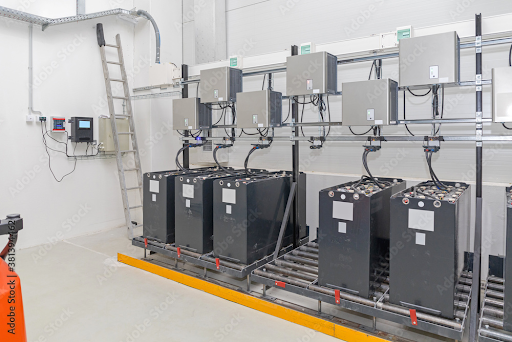
Our client operated a fleet of early-generation AGV technology that became less efficient as it aged. Replacement parts were becoming scarce and expensive, and the previous vendor had installed black-box software, preventing our client’s engineers from making adjustments without service calls. Adding to the difficulty, the legacy AGVs ran on giant lead-acid batteries that required constant attention from operators to pull and recharge at battery swap stations.
Sky-high maintenance costs and massive battery management stations strained their budgets and occupied valuable warehouse space.
When is it Time to Address Vendor Lock-In?
While the original solution was effective in the early days, as production needs changed, our client was unable to adapt. Vendor lock-in prevented facility engineers from making routine adjustments, optimizing workflows or troubleshooting issues. Every slight modification required scheduling a service call and waiting for vendor availability, which resulted in costly bottlenecks. Modernization was unavoidable. Our client needed a flexible approach that would replace broken systems without disrupting many of their existing processes and infrastructure.
The Solution
Partnering with Ralph W. Earl, a New York-based automated systems distributor, Hyperion developed a custom integration solution to replace outdated AGVs with a fleet of compact MiR 250s.
Fitted with custom-designed lift modules for unique bins, the new bots dramatically reduced the physical footprint of self-driving vehicles without compromising our client’s existing material-handling workflow.

Can you introduce AMRs without changing PLCs or reprogramming your entire infrastructure?
One of our goals was to retrofit the existing self-driving vehicle infrastructure without requiring our client to overhaul their entire material-handling workflow. The new AMR fleet needed to continue delivering the same empty bins to the manufacturing floor and collecting full bins for transport to the warehouse with as little disruption as possible.
Further, we wanted our solution to empower on-site engineers to handle changes as needed without the burden of vendor lock-in.
Addressing this challenge, our team wrote new applications that interfaced with the facility’s existing Allen-Bradley controllers, creating a bridge between existing PLCs and the AMR fleet software. The software relies on a REST API, a flexible interface that can communicate with virtually any system, giving the client the ability to expand and adapt the fleet as needs evolve.
Our team configured MiR fleet software to manage the AMRs, scheduling missions and tasks throughout the facility from a centralized system. The system coordinates all AMR activities, optimizing routes and preventing conflicts as robots navigate between stations.
Custom Lift Modules for Unique Bins
Different products require different bins and pallets for transportation—form factor, quantity and weight may differ, meaning there may not always be an out-of-the-box solution available. In these situations, Hyperion partners with AMR producers and our clients to design custom top modules that meet the client’s needs while pairing perfectly with the maker’s robot.
We created a custom top-module for the MiR 250 tailored to our client’s unique bins, these lift modules could raise and lower at floor-mounted docks throughout the facility to accommodate the client’s large tub-style bins, which could weigh in at 200 lbs fully loaded.
Floor mounted stands at each workstation provided consistent, predictable pickup and delivery points for the MiR 250s, and the custom lift module ensured secure handling throughout the process.
Real-Time Performance Data
MiR 250s come equipped with MiR Insights, an analytics package that provides real-time visibility into fleet performance. Our team deployed this to empower our client’s engineers to monitor barriers the robots encounter, review localization scores for accurate navigation, assess WiFi strength throughout the facility, and track overall fleet metrics.
Real-time feedback enables quick, informed decisions. When engineers trial a software or process change, they see the impact on robot performance immediately—supporting continuous optimization
Client Empowerment
Can facility engineers manage AMR fleets without vendor support?
Rather than create another locked system, Hyperion designed the integration to give the client’s engineers direct control. The facility’s advanced engineering team can now start and stop code, view error messages, and troubleshoot issues independently. When problems arise, they can often resolve them in-house and only escalate to Hyperion when necessary.
This autonomy extends to system optimization. The client’s engineers can make software adjustments to maps. If an AMR cuts a corner too close, they can modify the route themselves. This level of access wouldn’t have been possible with their old AGV system, marking a fundamental shift in how the facility manages its automation.
Modern Charging Infrastructure
MiR robots use internal lithium-ion batteries that they can recharge at compact docking stations on a schedule or automatically as needed. Not only did switching to modern AMRs eliminate an enormous amount of warehouse space, it also removed the need for operators to manually pull and charge heavy lead-acid batteries.
The entire battery-swap infrastructure, including massive shelving units, dedicated parking lanes, and dull work, was replaced by a few small docking stations.
The Results
Through strategic collaboration with Ralph W. Earl, Hyperion delivered a material-handling solution that transformed both the facility’s physical footprint and operational control.
Warehouse space reclaimed through compact fleet design. Through strategic collaboration with Ralph W. Earl, Hyperion delivered a material-handling solution that transformed both the facility’s physical footprint and operational control.
Manual battery operations eliminated. Operators no longer haul giant lead-acid batteries for manual charging. This shift saved both labor hours and reduced the potential for workplace injuries.
Engineers control their own fleet. When issues arise, the team resolves them in-house and escalates more complex issues to Hyperion when necessary. This self-sufficiency eliminated expensive vendor service calls and gave the client control over their automation timeline.
Real-time data enables continuous improvement. MiR Insights enables immediate impact on robot behavior. This feedback loop supports data-driven decisions and continuous system optimization.
Infrastructure designed for future growth. REST API integration allows the facility to expand the fleet or add new integrations as production demands evolve. The system adapts to changing needs rather than constraining operations to fit outdated technology, giving the manufacturer confidence in their long-term automation investment.
Partner with Hyperion
The right integration partner knows when to preserve what works and when to introduce new technology. Through close collaboration with distribution partners, we provide our customers with the technology, autonomy and reliability they need to be ready for the future.
Contact us today to discuss how custom AMR integration can transform your material handling operations.